Piszkéstető UHF
The Piszkéstető UHF station is a SatNOGS-capable satellite receiver station, suitable for receptions in the passband between 435 and 438 MHz. The station is based on the following components:
- SPID RAS rotator with off-the-shelf controller;
- 2x2 stacked WIMO X-Quad 70 cm UHF antennas (including the appropriate phase line);
- Aluminium tubes (40x2, 60x2);
- Cross mast clamps (for the H-shaped antenna support structure, for the counterweight) and distance mast clamps (for connecting the 60mm support tube to the bar);
- Wilkinson power combiner;
- An SSB SP-70 preamplifier (low-noise amplifier, LNA);
- N-N bias tee;
- N-N cables (H155, 4x 1m, exactly the same length to connect the antennas to the Wilkinson power combiner, 3m, to connect the power combiner with the LNA);
- An appropriately long N-N cable (H155, between the LNA and the bias tee);
- A shorter N-SMA cable (betweem the bias tee and the dongle);
- RTL-SDR dongle (v3);
- Lots of ferrite beads;
- PC Engines APU2 with Devuan single-board computer; and
- software stack extensions atop satnogs-client, enabling custom pre/postprocessing scripts and additional real-time packet decoding hooks.
Our infrastructure for this station infrastructure is supported by the same grants which funded the GRBAlpha mission, an 1U CubeSat for in-orbit performance tests of detectors suitable for small form-factor gamma-ray burst detections. The station also regularly receives the SMOG-1 PocketQube as well as we contribute to the data reception for the missions VZLUSAT-2, BDSat and Planetum-1. The aim of the custom extensions atop the satnogs-client is to allow the real-time decoding of GRBAlpha, VZLUSAT-2, BDSat and Planetum-1 packets and transfer the packets to the interactive ground control software with a minimal (≲ 10-20ms) latency while keeping a 100% compatible interfacing to the SatNOGS system at the same time. Our real-time packet forwarding is merged with additional stations, most prominently with the Jablonec SatNOGS station. In addition to this real-time packet forwarding, further extensions allows the proper unwinding of the antenna and rotator cabling in advance of the passes.
Gallery
-
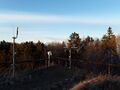 The station, mounted on the guard rails of the rooftop of the RCC telescope building.
 -
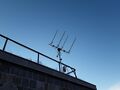 The station, a bottom view.
 -
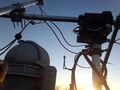 The dome of the 1-meter RCC telescope in the background of the antenna system. The dome blocks the horizon between 190...210 degrees of azimuth up to ~20 degs of elevation. In the sky background, one can see a SunExpress flight from Hannover to Diyarbakir.
 -
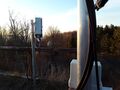 The mast supporting the station, along with the LNA (from the back) and a meteor camera and the dome of the Schmidt telescope in the background.
 -
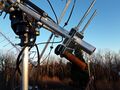 A lightweight counterweight... needed to be upgraded soon.
 -
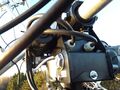 Cable glands of the main motor + encoder cables.
 -
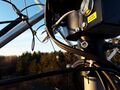 A close-up photo of the motor cable holder.
 -
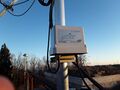 The low-noise amplifier.
 -
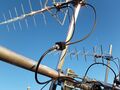 The phase line for one of the X-Quad antennas. In the sky background, one can see a Wizz Air flight from Bucharest to Birmingham.
 -
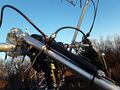 The 4-way Wilkinson power combiner.
 -
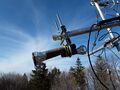
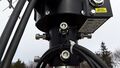 A close-up photo of the motor cable holder in order to avoid serious winding of the antenna and motor cables.
 -
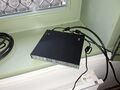 The off-the-shelf controller of the SPID RAS rotator, extended with numerous additional ferrite beads.
 -
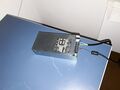 Power supply for the rotator, extended with a ferrite bead.
 -
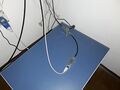 The bias tee and the RTL-SDR.
 -
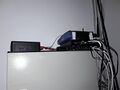 Some ethernet switches and the main PCEngines/APU control data acquisition computer.
 -
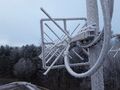 Christmas edition.
 -
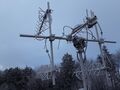 Some Christmas lights could also be wrapped around...
 -
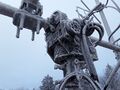 ... at least, the power supply is there for the Christmas lights.
 -
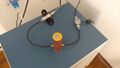 An additional cavity filter has been inserted later on in the path, but only after the LNA and bias tee (it is DC-short).
 -
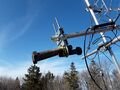 The well-balanced configuration: more big rusty screws have been mounted as counterweight...
 -
 ... with a bit of duct tape, just to be sure.


